
Operational Inefficiency in Modern Businesses & How AI Eliminates Workflow Bottlenecks
Modern businesses across industries are facing a growing and often underestimated challenge that directly impacts profitability, scalability, and long-term operational sustainability, which is the accumulation of hidden inefficiencies within day-to-day workflows that gradually slow down execution, increase operational costs, and reduce overall organizational responsiveness in ways that are not always immediately visible at the surface level but become significantly damaging over time as business complexity increases.
These inefficiencies typically emerge from fragmented systems, manual coordination between departments, inconsistent communication processes, and reliance on outdated operational models that were never designed to handle the scale, speed, and data intensity required in today’s business environment, resulting in bottlenecks that limit growth even in organizations that appear to be performing well externally but are internally struggling with operational friction and process misalignment.

Understanding the Real Cost of Operational Inefficiency
Operational inefficiency is often underestimated because it does not always appear as a direct cost on financial statements, yet it significantly affects revenue generation, employee productivity, customer satisfaction, and overall business agility by introducing delays, increasing error rates, and forcing teams to spend excessive time on repetitive administrative tasks that add little strategic value to the organization’s core objectives.
Over time, these inefficiencies compound and create structural limitations within the organization, where teams become overloaded with manual work, decision-making slows down due to lack of real-time information, and leadership is forced to rely on outdated reports that do not accurately reflect current business conditions, ultimately reducing the organization’s ability to respond effectively to market changes and competitive pressures.
Most businesses do not fail from lack of demand — they fail from internal operational friction.
How AI Identifies and Removes Workflow Bottlenecks
Artificial intelligence provides a powerful solution to operational inefficiency by analyzing business workflows in real time, identifying patterns of delay, redundancy, and misalignment across systems, and highlighting areas where automation and process redesign can significantly improve performance without requiring large-scale organizational restructuring or disruption to existing operations.
Through intelligent data processing and continuous monitoring, AI systems are able to map entire operational ecosystems, detect inefficiencies that are not easily visible to human teams, and recommend optimized workflows that reduce manual intervention, streamline communication between departments, and improve overall execution speed while maintaining accuracy and consistency across all business functions.
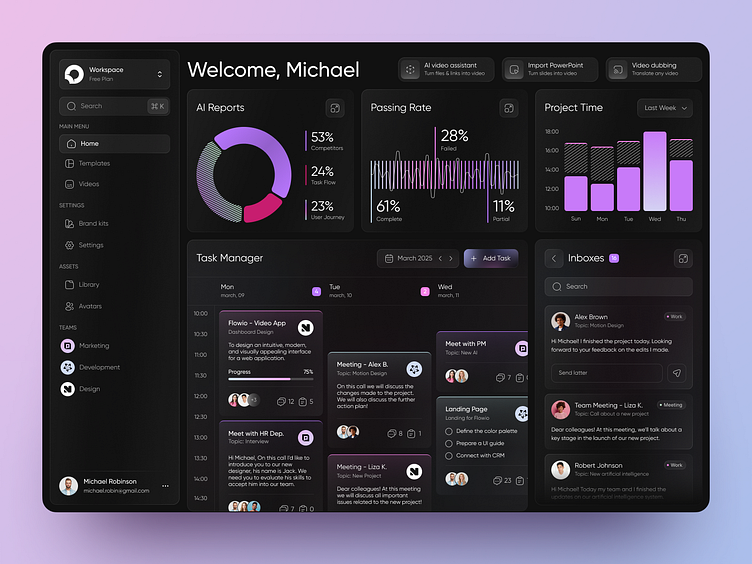
From Reactive Operations to Intelligent Systems
Traditional businesses operate in a reactive mode where decisions are made after problems occur, reports are generated after delays, and operational improvements are implemented only after inefficiencies have already impacted performance, whereas AI-driven organizations operate proactively by continuously analyzing data, predicting potential bottlenecks, and automatically optimizing workflows before issues escalate into larger operational problems.
This shift from reactive to intelligent operations fundamentally changes how businesses function, allowing them to move from static operational structures to dynamic systems that evolve continuously based on real-time data, ensuring that performance improves over time rather than degrading under increasing operational pressure and complexity.
Conclusion
Operational inefficiency is one of the most critical yet least visible challenges facing modern businesses, and its long-term impact can significantly restrict growth, reduce profitability, and weaken competitive positioning if left unaddressed, making it essential for organizations to adopt intelligent systems that can identify, analyze, and eliminate workflow bottlenecks before they become structural limitations.
AI and automation provide a direct pathway to resolving these challenges by transforming how work is executed, how decisions are made, and how systems interact within an organization, enabling businesses to operate with higher efficiency, greater scalability, and improved responsiveness in an increasingly competitive and fast-moving global marketplace where operational excellence determines long-term success.